
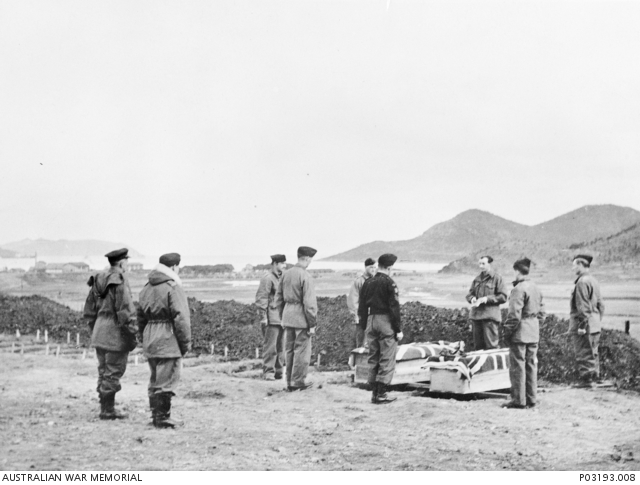
Courtesy of the AWM https://www.awm.gov.au/articles/blog/australian-padres-in-the-korean-war
The extraordinary military legacy of Father Elzear Basil Phillips, the "barefoot padre" who braved the frontlines of World War II and the Korean War, continues to inspire military historians and chaplains.
CANBERRA — The history of military chaplaincy is filled with stories of quiet courage, but few match the unique legacy of Father Elzear Basil Phillips. Known affectionately to thousands of Australian soldiers simply as "Fr. Joe," Phillips was a Discalced Carmelite priest who traded the quiet solitude of his monastery for the mud and gunfire of World War II and the Korean War. Armed only with his faith, he survived two of the 20th century’s bloodiest conflicts, earning a Member of the Order of the British Empire (MBE) for his legendary devotion to his men under fire.
Born in Hamilton, Victoria, in 1903, Phillips joined the Carmelite Order in 1929. As a Discalced—or "barefoot"—Carmelite, his vow of poverty meant he traditionally wore sandals without socks. When he enlisted in the Australian Army in July 1940, he maintained this practice as much as military regulations allowed, famously wearing heavy army boots completely without socks—even while enduring the agonizingly freezing winters of the Korean Peninsula.
A Veteran of Global Conflicts
Fr. Joe's military journey with the Australian Army spans multiple continents. During World War II, he deployed with the 2nd Australian Imperial Force (AIF) to the Middle East, ministering to troops across Africa, Palestine, and Syria. When the threat moved closer to home, he underwent intense jungle warfare training and accompanied the troops into the thick of combat in New Guinea and Borneo.
Following the end of World War II, he served with the British Commonwealth Occupation Force (BCOF) in Japan before deploying to the Korean War with the 3rd Battalion, Royal Australian Regiment (3RAR). His extensive service record eventually made him the longest-serving member of his battalion.
Heroism at Kapyong
While chaplains were technically non-combatants, Fr. Joe refused to stay safely behind the lines. Historical records from the Australian War Memorial note that he was a "quiet and pious" man with a civilian passion for horse racing, but on the battlefield, he possessed nerves of steel.
During the ferocious Battle of Kapyong in April 1951—where 3RAR famously stalled a massive enemy advance toward Seoul—Fr. Joe and his fellow padres actively worked as frontline stretcher-bearers. They repeatedly exposed themselves to heavy enemy fire to drag wounded soldiers back to safety and administer final unction to the dying.
An Enduring Legacy
For his fearless actions and unwavering commitment, Fr. Joe was awarded an MBE in 1952. Decades later, his story serves as a profound reminder of the evolving, yet historically vital role that military chaplains play. While modern warfare and military psychology have shifted, the image of the barefoot Carmelite priest walking the frozen trenches of Korea without socks, bringing comfort to the wounded, remains a towering symbol of selfless service in Australian military history.
Courtesy: CMOA Media Team